Colorado can serve up sunshine, freezing temperatures, wind, and snow in the same week. For drivers in Denver and along the Front Range, those rapid changes are more than an inconvenience. They affect tire pressure, battery performance, fluids, rubber components, and the way an engine responds at higher elevations.
Most modern vehicles are designed to compensate for changing conditions, but no vehicle is immune to wear. Understanding what Colorado's altitude and temperature swings do to your car can help you catch small problems before they turn into a no-start, a damaged tire, or an overheating engine on the way into the mountains.
Cold Weather Changes Tire Pressure
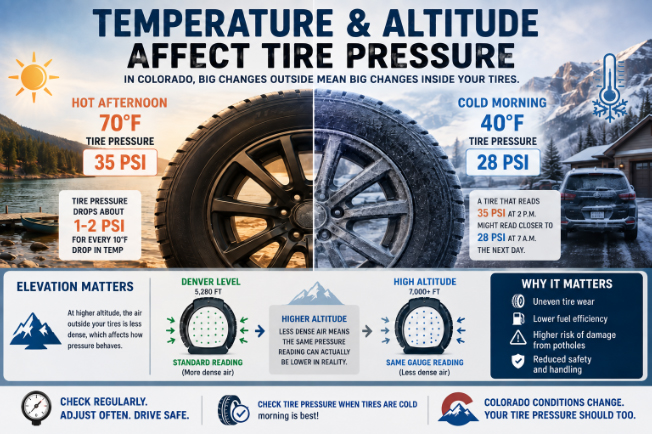
Tire pressure changes with temperature. A useful rule of thumb is that pressure changes by about 1-2 PSI for every 10-degree Fahrenheit change in air temperature. If your tires were set to 35 PSI on a 70-degree afternoon, a 40-degree temperature drop could leave them near 28-32 PSI the next morning. That is enough to trigger the tire-pressure warning light on some vehicles.
Check pressure when the tires are cold, ideally before driving or after the vehicle has been parked for several hours. Inflate each tire to the cold-pressure specification on the driver's-door-jamb label, not the maximum pressure printed on the tire sidewall. Do not intentionally overinflate the tires to prepare for a mountain trip or a warmer afternoon.
Altitude can also change a pressure-gauge reading because a tire gauge measures pressure relative to the surrounding air. The effect during a typical drive from Denver into the mountains is usually smaller than the effect of a major temperature swing, so the door-jamb specification remains the right target.
Why Proper Inflation Matters
Underinflation allows the tire to flex more, which creates heat and can accelerate shoulder wear. It can also hurt steering response and fuel economy. Overinflation reduces the size of the tire's contact patch and can contribute to center wear or a harsher ride. Neither condition is helpful when you are dealing with snow, potholes, or a sudden Colorado cold front.
A tire-pressure monitoring system is an important warning device, but it should not replace a monthly pressure check. The warning light may not appear until one or more tires are already well below the recommended pressure. While checking pressure, inspect the tread and sidewalls for uneven wear, cracking, bulges, or embedded objects.
Cold Weather Exposes Weak Batteries
Low temperatures slow the chemical reaction inside a conventional 12-volt battery, reducing the power available to crank the engine. At the same time, cold engine oil increases starting resistance. A battery that seemed normal during mild weather may crank slowly or fail when the first hard freeze arrives.
Summer heat often contributes to internal battery deterioration, while winter cold exposes the lost capacity. That is why battery condition matters before temperatures fall. Warning signs include slow cranking, dim lights during startup, repeated jump-starts, electrical glitches, or a battery warning light. Corroded or loose terminals can create similar symptoms and should be inspected as part of the diagnosis.
Higher elevation is not usually the direct cause of a battery failure. Modern fuel-injected engines use sensors and computer controls to adjust the air-fuel mixture as air density changes. However, a cold start at altitude can still reveal an existing weakness in the battery, charging system, fuel delivery, ignition system, or engine controls.
Freeze Thaw Cycles Accelerate Wear
Repeated heating and cooling make rubber and plastic components expand and contract. With age, belts, coolant hoses, vacuum lines, wiper blades, weather seals, and plastic connectors can become brittle or develop cracks. Cold weather may also expose a marginal seal or gasket by causing a small leak to become more noticeable.
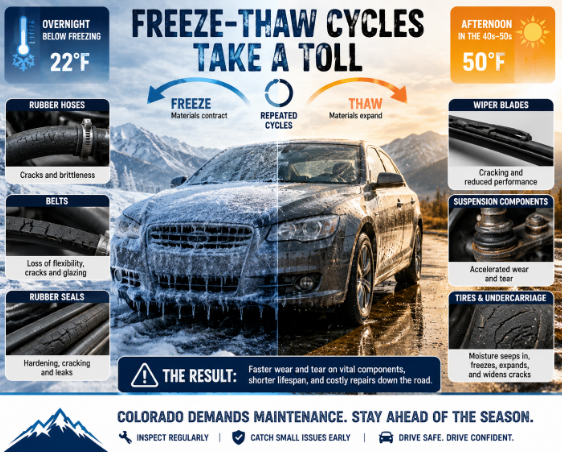
Road moisture and deicing chemicals add another layer of stress. Slush can collect around suspension and underbody components, then freeze. Road treatment residue can hold moisture against metal surfaces and promote corrosion. Regular washing, including the underbody during winter, helps remove buildup. An inspection is worthwhile if you notice fluid spots, a new squeak, a loose splash shield, torn boots, or steering and suspension noises after a freeze.
Fluids Behave Differently in the Cold
Engine oil, transmission fluid, power-steering fluid on vehicles that use it, and gear oil all become more resistant to flow when cold. Using the manufacturer-specified fluid type and viscosity helps the vehicle lubricate components properly during startup. A heavier oil is not automatically better for winter protection.
Coolant protection matters year-round. The correct coolant mixture helps prevent freezing in winter and raises the boiling point for summer and mountain driving. Low coolant, an incorrect mixture, a weak pressure cap, or a small leak can lead to poor heater performance or overheating. Never remove a pressurized cooling-system cap while the engine is hot.
Altitude Affects Engine Performance
Air becomes less dense as elevation increases. Naturally aspirated engines may produce less power on a climb because less oxygen enters the cylinders. Turbocharged engines can compensate better, but they may still work harder and generate more heat under sustained load. Drivers often notice more downshifting, higher engine speed, or reduced acceleration while climbing I-70.
A noticeable misfire, flashing check-engine light, overheating warning, severe power loss, or strong fuel smell is not a normal altitude response. Reduce the load, move to a safe location, and have the vehicle checked. Continuing to drive with a flashing check-engine light can damage the catalytic converter.
A Practical Colorado Seasonal Checklist
Before the first sustained freeze, check tire pressure and tread depth, test the battery and charging system, confirm coolant condition and freeze protection, inspect belts and hoses, replace worn wiper blades, and verify that the heater and defroster work properly. Keep the fuel level reasonable, carry season-appropriate emergency supplies, and make sure your spare tire or inflator kit is usable.
Repeat a quick tire-pressure check after a major temperature drop and before a long mountain drive. If the tire-pressure light flashes, stays on after inflation, or returns repeatedly, the vehicle may have a leak or a monitoring-system fault that needs attention.
Prepare Your Vehicle at Hotchkiss Auto Repair
At Hotchkiss Auto Repair in Denver, our team understands what Front Range weather and high-country driving demand from a vehicle. We can inspect your tires, battery, charging system, cooling system, belts, hoses, fluids, wipers, and other seasonal trouble spots, then explain what needs attention now and what can be monitored.
If your car has been slow to start, the tire-pressure light keeps returning, or you want confidence before the next cold snap or mountain trip, schedule an appointment with Hotchkiss Auto Repair. Our qualifying repairs are backed by a 36-month or 36,000-mile warranty, giving you added confidence wherever Colorado takes you.